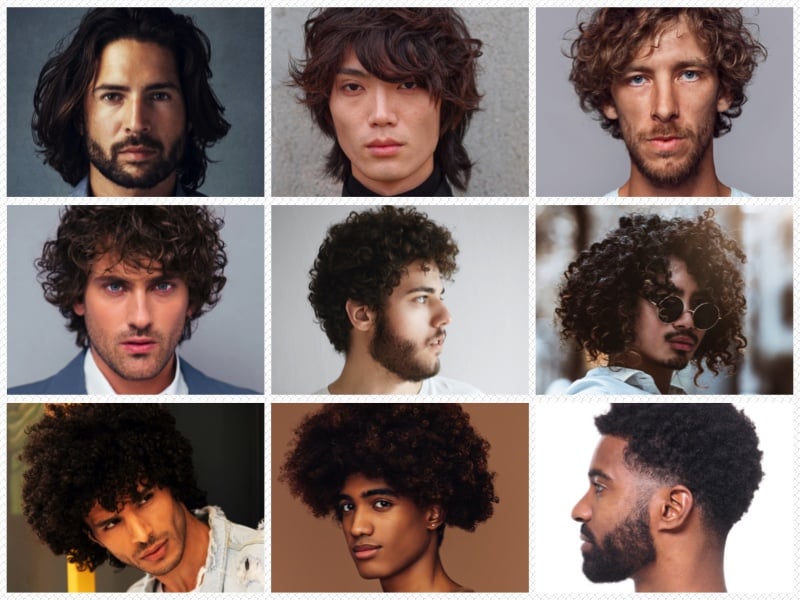
Curly hair types describe a strand's natural pattern, from loose waves to tight coils. The chart commonly used today grew from stylist Andre Walker's classification system. Types 2, 3, and 4 identify waves, curls, and coils, with A, B, and C indicating progressively tighter patterns within each group. That vocabulary helps when choosing haircuts for curly hair, while strand thickness and condition also affect products and care.
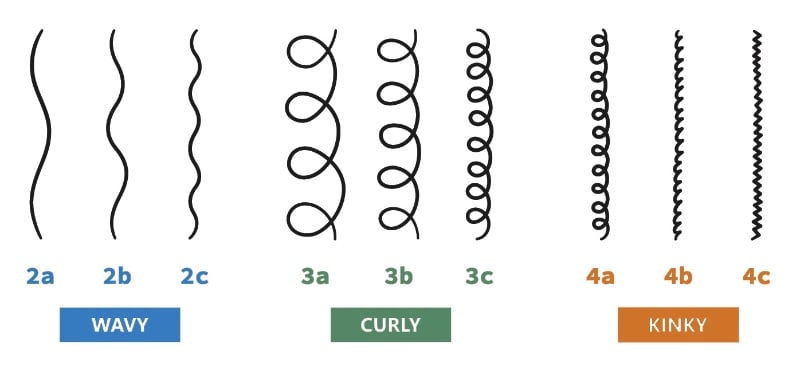
The Curly Hair Types Chart
Type 1 is straight hair, so the chart for curly hair starts at type 2.
| Type | Pattern | What it looks like |
|---|---|---|
| 2A | Loose waves | A slight bend, close to straight |
| 2B | Defined waves | Clear S-shaped waves that start mid-length |
| 2C | Strong waves | Deep S-waves from the roots, close to curls |
| 3A | Loose curls | Large, loose spirals |
| 3B | Springy curls | Tighter ringlets, about the width of a marker |
| 3C | Tight curls | Dense corkscrews, about the width of a pencil |
| 4A | Soft coils | Small, defined S-shaped coils |
| 4B | Z-pattern coils | Tight coils with sharp, zigzag bends |
| 4C | Tight coils | Very tight coils with little visible pattern |
Several patterns can appear on the same person, with looser bends in one area and tighter curls in another. Use the predominant type as a shorthand, then note any areas that behave differently.
Type 2: Wavy Hair
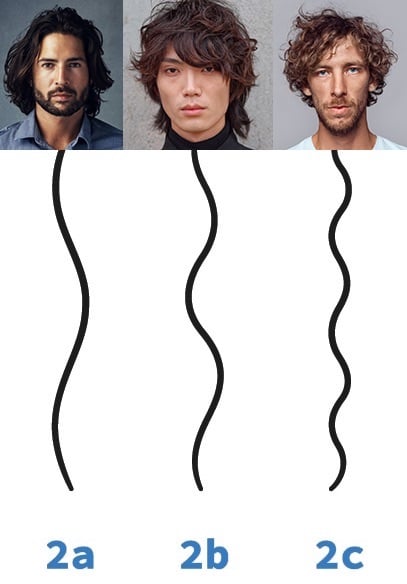
S-shaped bends distinguish type 2 hair from the full spirals of type 3. The waves may lie close to the scalp or lift away in deeper ridges. Length can make those bends more visible, as with wavy hair worn past the ears.
2A Hair
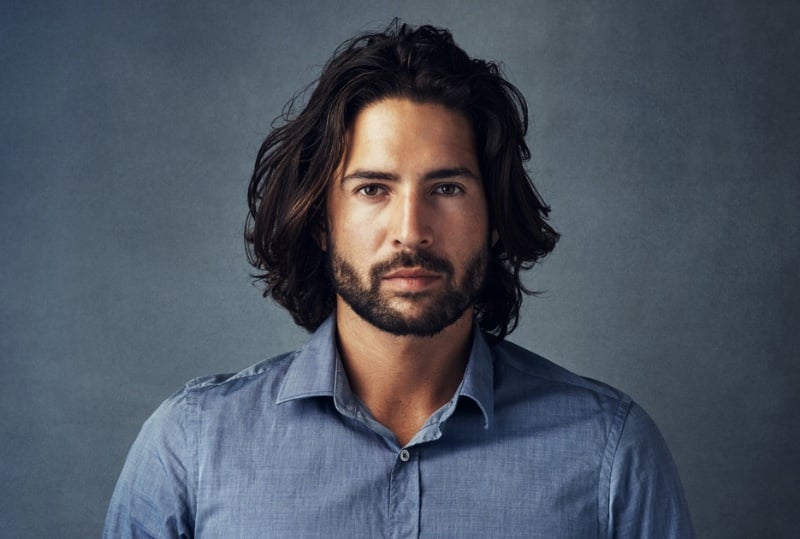
A slight bend separates 2A hair from straight hair. At shorter lengths, the wave may appear only at the ends. Fine strands can flatten under heavy cream, so a small amount of mousse is a lighter starting point.
2B Hair

In 2B hair, a clearer S-shape often develops through the mid-lengths while the roots lie flatter. A light gel can help adjacent strands dry together in defined waves, especially when humidity leaves the ends frizzy.
2C Hair

The deeper waves of 2C hair begin close to the roots and can turn into loose curls at the ends. The pattern gives the top more lift than 2A or 2B. Strand thickness still varies, so a pronounced wave does not automatically call for a heavy product.
Type 3: Curly Hair
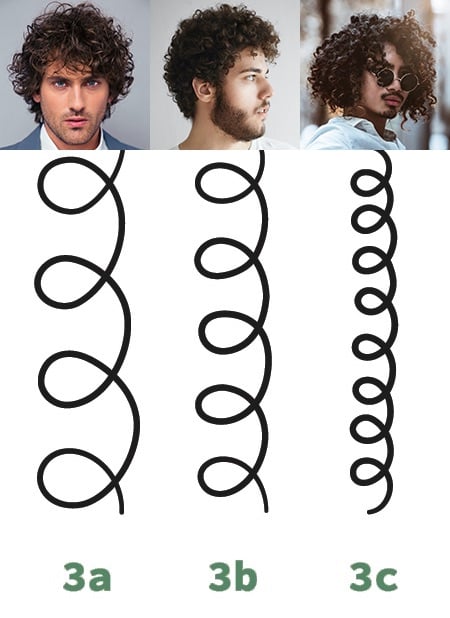
Type 3 hair forms full spirals, ranging from broad loops to narrow corkscrews. Several strands gather into each visible curl. Brushing dry hair separates those groups and can leave the outline fuller and less defined.
3A Hair

Large, open spirals mark 3A hair. With enough length, the curls fall in broad loops, though weight may stretch them nearer the roots. Light gel can help the loops retain their shape as they dry.
3B Hair

3B ringlets wind more tightly than 3A curls and spring back into smaller loops. Their repeated curves give the top a rounded outline. Styling in sections helps distribute product through the hair instead of coating only the outer curls.
3C Hair

Narrow corkscrews distinguish 3C hair. The tight turns can gather closely, making it difficult to reach the inner layers when conditioning. Work through smaller sections and detangle gently while the hair is wet and conditioned.
Type 4: Coily Hair
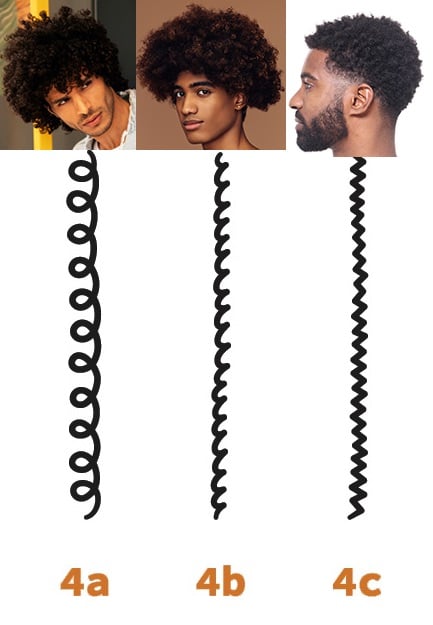
Type 4 hair forms small coils or tight, angular bends that draw the visible length upward as the hair dries. That shrinkage contributes to the silhouette of afros and high tops. Twists and locs arrange the strands into longer sections. Gentle detangling matters because tightly curled strands can catch around one another.
4A Hair

Small S-shaped coils remain visible in 4A hair, even as they spring close to the scalp. The ends curl back toward neighboring strands, so separate tangles from the ends upward instead of pulling through them from the roots.
4B Hair
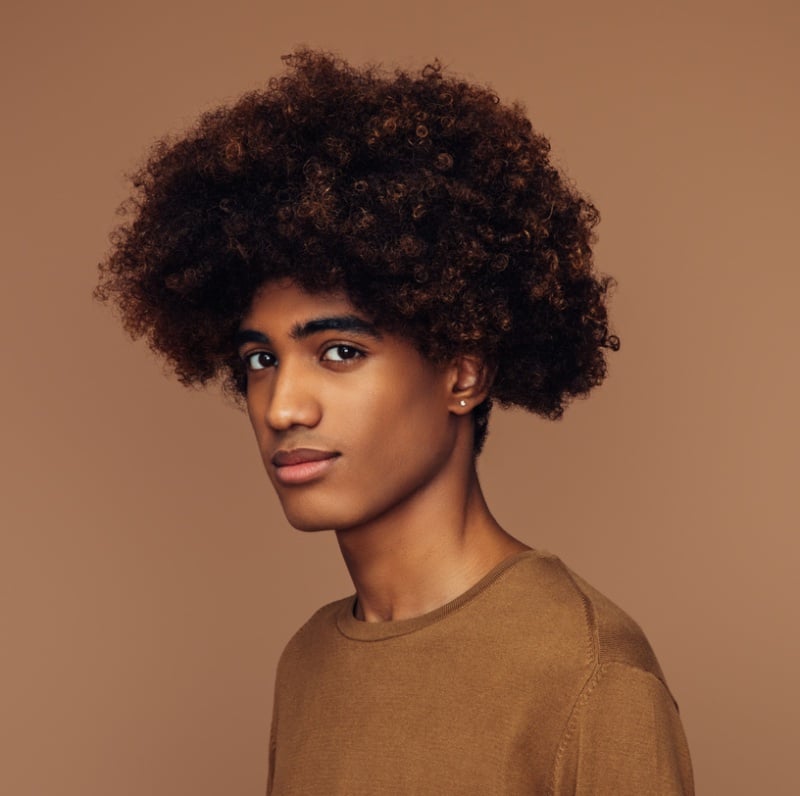
4B hair bends at sharper angles, creating a zigzag pattern. Those turns can make the dry hair look much shorter than its stretched length. A barber needs to allow for that difference when setting the top's length and outline.
4C Hair
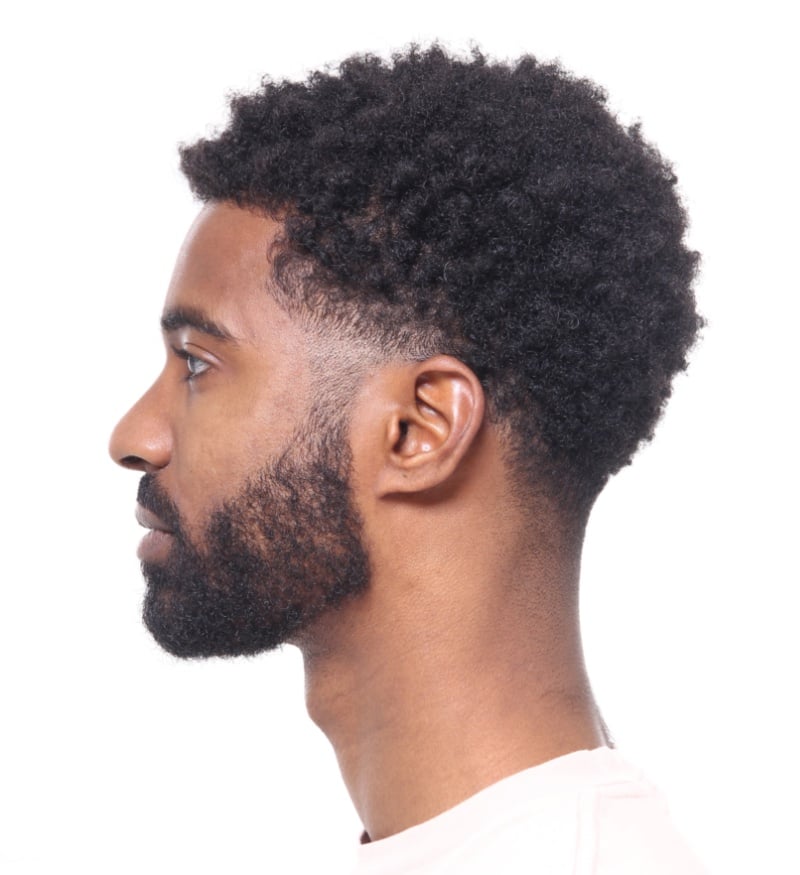
The very tight coils of 4C hair can be difficult to distinguish individually in their natural state. Shrinkage can conceal considerable length, and strand thickness varies within this type. Gentle handling and conditioning help limit tangles as it gets longer. Trim worn or split ends as needed.
How to Tell Curl Type

Observe freshly washed hair after it has air-dried, before adding styling products or stretching it into a style. Match its natural bends, loops, or coils to the chart. Check the front, sides, crown, and nape, since one label may not describe every area. Very short hair may need more length before its pattern becomes apparent.
Porosity, Elasticity & Other Factors
Curl type describes shape. Porosity, elasticity, strand thickness, and density help explain why two people with similar curls may need different care. Consider how the hair feels and responds to washing and styling when choosing curly hair products.
Porosity

Porosity describes how readily water enters and leaves the hair fiber. Lower-porosity hair resists wetting, while more porous hair absorbs water more readily. Chemical processing and heat damage can alter this behavior, so porosity may differ between the roots and older ends.
Notice how clean hair wets in the shower and feels after conditioning. Water beading on the surface can offer a clue, but product residue also affects wetting. Absorption and drying time alone do not establish a porosity level.
Start with lighter conditioners if products collect on the surface or leave the hair limp. Drier, damaged lengths may benefit from a richer conditioner. Adjust the amount and formula according to softness, residue, and tangling instead of treating a porosity label as a fixed prescription.
Elasticity

Elasticity is a strand's ability to stretch and recover before it breaks. Some stretch is normal, especially when hair is wet. Repeated snapping or a gummy feel can signal damage, though a home check cannot identify its cause.
If checking a shed wet strand, stretch it gently and stop before forcing it to break. A strand that snaps or stays elongated does not, by itself, establish a need for moisture or protein. Review heat, chemical processing, and rough handling before selecting another treatment.
Thickness & Density

Thickness is the width of an individual strand. Density is the number of strands growing across an area of scalp. Fine hair can still be dense, and coarse strands can be sparse. Fine strands may flatten under rich cream, while greater density can make even product distribution harder. Both affect how full a cut looks.
Using Curl Type to Choose a Cut

Use curl type to discuss how the finished cut should fall. Waves and looser spirals can sweep across a middle part or rise into a quiff, while a forward fringe gives curly French crops their rounded edge. Tighter curls and coils can support high tops and afros. With a taper fade, ask where the short sides should meet the longer curls. Show the barber the natural dry pattern so the cut allows for shrinkage.





